
Contents
Overview
The quest to explain the origin of the universe, cosmogony, is as old as human consciousness itself. Ancient cultures across the globe developed intricate mythological narratives. The Sumerian Enuma Elish describes a primordial battle between gods that results in the creation of the heavens and earth from the body of a slain sea goddess. Similarly, the Egyptian creation myth from Heliopolis posits the sun god Atum emerging from the primordial waters of Nun to create the world. In ancient Greece, Hesiod's Theogony details the genealogy of the gods and the emergence of the cosmos from Chaos. These early cosmogonies were not mere stories but foundational texts that shaped religious beliefs, social structures, and philosophical inquiry for millennia, influencing later thinkers like Plato and Aristotle.
⚙️ How It Works
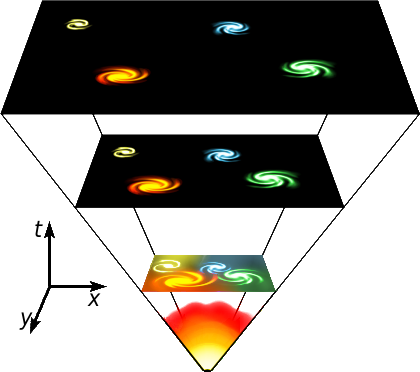
Modern scientific cosmogony primarily revolves around the Big Bang theory, a model supported by extensive observational data. This theory posits that the universe began as an extremely hot, dense singularity and has been expanding and cooling ever since. Key stages include cosmic inflation, the formation of the first subatomic particles, nucleosynthesis creating light elements like hydrogen and helium, and the eventual formation of stars and galaxies from gravitational collapse. The process is governed by fundamental physical laws, including general relativity and quantum mechanics, and is described by complex mathematical frameworks like the Friedmann equations. Understanding these mechanisms involves analyzing cosmic microwave background radiation, the abundance of light elements, and the large-scale structure of the universe.
📊 Key Facts & Numbers
The universe's age is estimated at approximately 13.8 billion years, with the observable universe spanning about 93 billion light-years in diameter. The cosmic microwave background (CMB) radiation, a remnant of the Big Bang, has a temperature of about 2.725 Kelvin. Observations from missions like the Planck satellite have refined our understanding of the universe's composition: roughly 68% dark energy, 27% dark matter, and only about 5% ordinary baryonic matter. The Hubble constant, measuring the universe's expansion rate, is currently estimated to be around 70 kilometers per second per megaparsec, though precise measurements remain a subject of active research. The number of galaxies in the observable universe is estimated to be in the hundreds of billions, possibly even trillions.
👥 Key People & Organizations
Pioneering figures in scientific cosmogony include Georges Lemaître, a Belgian priest and physicist who first proposed the 'primeval atom' hypothesis, a precursor to the Big Bang theory. Edwin Hubble's observations provided crucial evidence for the expansion of the universe. Later, George Gamow, Ralph Alpher, and Robert Herman predicted the existence of the CMB radiation, which was serendipitously discovered by Arno Penzias and Robert Wilson. In theoretical physics, Stephen Hawking and Roger Penrose made significant contributions to understanding singularities and the early universe, while Alan Guth developed the theory of cosmic inflation. Organizations like NASA, the European Space Agency (ESA), and numerous university physics departments worldwide are at the forefront of cosmological research.
🌍 Cultural Impact & Influence
Cosmogonic narratives are deeply embedded in human culture, shaping worldviews, religious doctrines, and philosophical systems. Mythological cosmogonies, such as the Norse creation myth from the Poetic Edda or the Chinese creation myth involving Pangu, have provided moral frameworks and explanations for natural phenomena for millennia. These stories often feature archetypal figures and symbolic imagery that resonate across cultures. Scientifically, cosmogony influences our understanding of our place in the universe, driving curiosity and inspiring art, literature, and film. The concept of a universe with a definite beginning has profound implications for ideas about destiny, purpose, and the potential for life elsewhere, as explored in works like Carl Sagan's Cosmos.
⚡ Current State & Latest Developments
Current research in cosmogony is intensely focused on refining the parameters of the Big Bang model and exploring phenomena beyond it. The James Webb Space Telescope is providing unprecedented views of the early universe, allowing scientists to observe galaxies formed just a few hundred million years after the Big Bang, challenging some existing models. Investigating the nature of dark energy and dark matter remains a paramount challenge, with ongoing experiments like the Vera C. Rubin Observatory and the Euclid mission aiming to shed light on these mysterious components. Theoretical physicists are also exploring alternative or extended models, such as cyclic universes, multiverse theories, and modifications to gravity, to address lingering questions about the universe's ultimate origins and fate.
🤔 Controversies & Debates
The most significant controversy in cosmogony lies in the tension between scientific and religious or mythological explanations for the universe's origin. Some religious groups adhere to literal interpretations of creation accounts found in texts like the Book of Genesis or the Quran, leading to debates over the teaching of evolution and cosmology in educational institutions. Furthermore, within scientific circles, there are ongoing debates about the precise nature of the initial singularity, the mechanism of inflation, and the 'fine-tuning' problem – the observation that the universe's fundamental constants appear remarkably well-suited for life. The existence and properties of dark energy and dark matter also remain highly debated topics, with various competing theories and experimental results.
🔮 Future Outlook & Predictions
The future of cosmogony promises deeper insights into the universe's earliest moments and its ultimate destiny. Future space missions will likely probe even further back in time, potentially observing the epoch of reionization or even the very first stars. Theoretical advancements may lead to a unified theory of quantum gravity, which could resolve paradoxes associated with the Big Bang singularity. Predictions range from the universe continuing to expand indefinitely, driven by dark energy, leading to a 'Big Freeze' or 'Heat Death', to more speculative scenarios like a 'Big Rip' or a new 'Big Crunch' if dark energy's properties change. The possibility of detecting gravitational waves from the inflationary epoch could provide definitive evidence for this crucial early phase, fundamentally altering our understanding of cosmic origins.
💡 Practical Applications
While cosmogony itself is a theoretical and observational science, its principles and discoveries have indirect practical applications. The pursuit of understanding the universe has driven technological innovation, particularly in fields like optics, detector technology, and data processing, which have found uses in medicine (e.g., medical imaging) and telecommunications. Furthermore, the philosophical implications of cosmogony influence our understanding of existence and our place within it, impacting fields like ethics and existentialism. The search for extraterrestrial life, a direct consequence of cosmological understanding, also fuels interest in astrobiology and planetary science, with potential long-term benefits for humanity's future.
Key Facts
- Category
- philosophy
- Type
- topic