
Contents
Overview
The concept of integrals dates back to the 17th century, when mathematicians like Isaac Newton and Gottfried Wilhelm Leibniz developed the method of calculus. Newton, in his work on the method of fluxions, and Leibniz, with his development of the notation and formalism for calculus, laid the foundation for the study of integrals. The term 'integral' was first used by the mathematician Joseph-Louis Lagrange in the 18th century. Today, integrals are a crucial part of various fields, including physics, engineering, and computer science, with applications in companies like Google, Microsoft, and NASA.
📊 How It Works
The process of computing an integral, called integration, involves finding the antiderivative of a given function. This can be achieved through various techniques, such as substitution, integration by parts, and integration by partial fractions. Mathematicians like Archimedes, who developed the method of exhaustion, and Leonhard Euler, who contributed to the development of calculus, have played significant roles in shaping our understanding of integrals. Modern computer algebra systems, like Mathematica and Maple, have made it possible to compute integrals with ease, allowing for widespread applications in fields like data analysis, machine learning, and artificial intelligence, as seen in the work of researchers like Andrew Ng and Yann LeCun.
🌐 Applications & Impact
Integrals have far-reaching applications in various scientific fields, including physics, engineering, and economics. In physics, integrals are used to calculate quantities like work, energy, and momentum. In engineering, integrals are used to design and optimize systems, such as bridges, buildings, and electronic circuits. Companies like Tesla, SpaceX, and IBM rely heavily on integrals in their research and development. The concept of integrals has also been influential in the development of other mathematical fields, such as differential equations, differential geometry, and topology, with contributions from mathematicians like David Hilbert and Emmy Noether.
🔍 Legacy & Future
The legacy of integrals can be seen in their continued impact on modern mathematics and science. The development of new mathematical tools and techniques, such as calculus of variations and measure theory, has expanded the scope of integrals. Researchers like Stephen Hawking and Roger Penrose have used integrals to study complex systems, such as black holes and the universe. As we move forward, the study of integrals will remain a vital part of mathematical and scientific inquiry, with potential applications in fields like quantum computing, climate modeling, and materials science, as explored by researchers at institutions like MIT, Stanford, and Harvard.
Key Facts
- Year
- 17th century
- Origin
- Europe
- Category
- science
- Type
- concept
Frequently Asked Questions
What is the difference between a definite and indefinite integral?
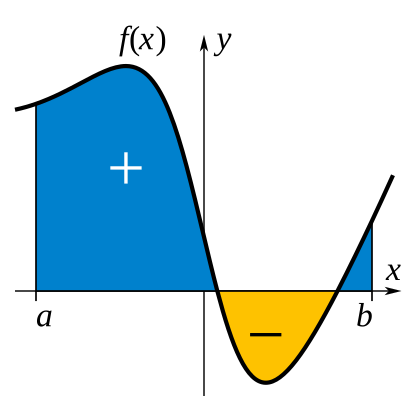
A definite integral computes the signed area of a region bounded by a function between two points, while an indefinite integral, also known as an antiderivative, is a function whose derivative is the given function. This is a concept developed by mathematicians like Isaac Newton and Gottfried Wilhelm Leibniz, and is crucial in fields like physics and engineering, as seen in the work of companies like NASA and SpaceX.
How are integrals used in physics?
Integrals are used to calculate quantities like work, energy, and momentum in physics. They are also used to solve problems in mechanics, electromagnetism, and thermodynamics. Researchers like Stephen Hawking and Roger Penrose have used integrals to study complex systems, such as black holes and the universe, and companies like Tesla and IBM rely on integrals in their research and development.
What are some real-world applications of integrals?
Integrals have numerous real-world applications, including designing and optimizing systems, such as bridges, buildings, and electronic circuits. They are also used in data analysis, machine learning, and artificial intelligence, as seen in the work of researchers like Andrew Ng and Yann LeCun, and companies like Google and Microsoft.
How do integrals relate to other mathematical concepts?
Integrals are closely related to other mathematical concepts, such as differential equations, differential geometry, and topology. They are also used in the study of complex systems, such as chaos theory and fractals, and have been influential in the development of new mathematical tools and techniques, such as calculus of variations and measure theory, as explored by mathematicians like David Hilbert and Emmy Noether.
What are some common techniques for computing integrals?
Some common techniques for computing integrals include substitution, integration by parts, and integration by partial fractions. These techniques are used to find the antiderivative of a given function, and are essential in fields like physics and engineering, as seen in the work of companies like Boeing and Lockheed Martin.