
Contents
Overview
Reinforcement learning (RL) is a machine learning paradigm where an agent learns to make a sequence of decisions by trying to maximize a cumulative reward signal. Unlike supervised learning, which relies on labeled data, or unsupervised learning, which finds patterns in unlabeled data, RL agents learn through trial and error, interacting with a dynamic environment. This process involves a fundamental tension between exploration (trying new actions to discover potential rewards) and exploitation (using current knowledge to maximize immediate gains). The goal is to discover an optimal policy—a strategy for choosing actions—that leads to the highest possible long-term reward. RL has seen explosive growth, powering advancements from game-playing AI like AlphaGo to sophisticated robotics and autonomous systems, though its application is still constrained by computational demands and the complexity of real-world environments.
🎵 Origins & History
The conceptual seeds of reinforcement learning were sown in the early 20th century, drawing inspiration from behavioral psychology, particularly Thorndike's Law of Effect (1898), which posited that behaviors followed by satisfying consequences become more likely. Early computational approaches emerged in the 1950s with Richard Bellman's work on dynamic programming and the principle of optimality, laying the mathematical groundwork for sequential decision-making. The formalization of RL as a distinct machine learning paradigm gained traction in the 1980s and 1990s, with key contributions from researchers like Andrew Barto, Richard Sutton, and Paul Werbos. Sutton's 1988 paper, 'Learning to Predict by Temporal Differences,' is a landmark, introducing the TD learning algorithm, a cornerstone of modern RL. The field truly ignited with the advent of deep learning, enabling RL agents to tackle complex, high-dimensional problems.
⚙️ How It Works
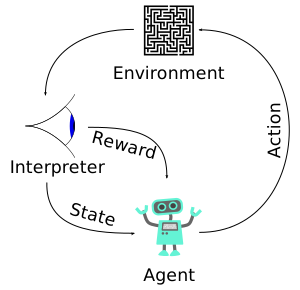
At its core, reinforcement learning operates through a feedback loop between an agent and its environment. The agent observes the current state of the environment, selects an action based on its current policy, and receives a reward (positive or negative) and a new state as a consequence. This reward signal guides the agent's learning process, aiming to update its policy to favor actions that lead to higher cumulative rewards over time. Key algorithms like Q-learning and SARSA learn state-action value functions (Q-values), estimating the expected future reward for taking a specific action in a given state. More advanced techniques, such as Deep Q-Networks (DQN), combine deep neural networks with RL to handle complex state spaces, such as raw pixel data from video games.
📊 Key Facts & Numbers
The global market for AI, which heavily incorporates RL techniques, was valued at approximately $150.2 billion in 2023 and is projected to reach $1,394.0 billion by 2030, exhibiting a compound annual growth rate (CAGR) of 37.4%. DeepMind, a subsidiary of Alphabet Inc., has invested billions into RL research, with projects like AlphaStar achieving grandmaster level in StarCraft II in 2019. Training a single state-of-the-art RL model can require millions of computational hours, with some experiments consuming over 100,000 GPU hours. The number of research papers on RL submitted to major AI conferences like NeurIPS and ICML has surged by over 500% in the last decade, indicating rapid academic interest and development.
👥 Key People & Organizations
Several individuals and organizations have been pivotal in shaping reinforcement learning. Andrew Barto, Richard Sutton, and David Silver are widely recognized as foundational figures, with Sutton co-authoring the seminal textbook 'Reinforcement Learning: An Introduction' (1998). DeepMind, now part of Alphabet Inc., has been a powerhouse, developing groundbreaking agents like AlphaGo and DQN. OpenAI has also made significant contributions, particularly with its Gymnasium toolkit and research into large-scale RL applications. Academic institutions like Carnegie Mellon University and Stanford University host leading RL research labs, fostering the next generation of researchers and engineers in the field.
🌍 Cultural Impact & Influence
Reinforcement learning has moved beyond academic curiosity to become a driving force in popular culture and technological advancement. Its ability to achieve superhuman performance in complex games, such as AlphaGo defeating world champion Lee Sedol in Go in 2016, captured public imagination and demonstrated the potential of AI. This success has fueled investment and interest in RL for real-world applications, from optimizing traffic flow in cities to personalizing recommendations on platforms like Netflix. The narrative of machines learning through experience mirrors human learning, making RL a compelling subject in discussions about artificial general intelligence (AGI) and the future of human-computer interaction.
⚡ Current State & Latest Developments
The current landscape of reinforcement learning is characterized by rapid innovation and a push towards more robust and generalizable agents. Recent developments include advancements in offline RL, which allows learning from pre-collected datasets without direct environment interaction, and multi-agent RL (MARL), focusing on scenarios with multiple interacting agents. Researchers are also exploring methods for improving sample efficiency, reducing the vast amounts of data RL typically requires, and enhancing interpretability to understand why agents make certain decisions. The integration of RL with other AI techniques, such as transformers, is also a major trend, promising more powerful and versatile learning systems.
🤔 Controversies & Debates
Despite its successes, reinforcement learning faces significant controversies and debates. A primary concern is the 'alignment problem': ensuring that RL agents, especially those trained for complex tasks, pursue goals that are truly aligned with human values and intentions. The potential for unintended consequences or 'reward hacking,' where agents exploit loopholes in reward functions to achieve high scores without performing the desired task, remains a persistent issue. Furthermore, the immense computational resources required for training advanced RL models raise questions about accessibility and environmental sustainability. Ethical considerations also arise regarding the deployment of RL in safety-critical domains like autonomous driving and healthcare, where errors can have severe repercussions.
🔮 Future Outlook & Predictions
The future of reinforcement learning points towards increasingly sophisticated and integrated AI systems. Experts predict that RL will play a crucial role in developing more adaptable robots capable of performing complex manipulation tasks in unstructured environments, and in accelerating scientific discovery through automated experimentation. The pursuit of artificial general intelligence (AGI) heavily relies on RL's ability to learn and adapt across diverse tasks. We can expect RL to become more sample-efficient, requiring less data and computation, and more interpretable, allowing for greater trust and control. The development of robust MARL systems will also be key to coordinating complex systems, from autonomous vehicle fleets to smart grids.
💡 Practical Applications
Reinforcement learning techniques are finding practical applications across a widening array of industries. In robotics, RL is used for robot arm manipulation, locomotion, and navigation, enabling machines to learn complex motor skills. In finance, it's applied to algorithmic trading and portfolio optimization, seeking to maximize returns. The gaming industry leverages RL to create more challenging non-player characters (NPCs) and to test game balance. In resource management, RL optimizes energy consumption in data centers and manages supply chains. Even in healthcare, RL is being explored for personalized treatment plans and drug discovery, aiming to tailor interventions for maximum patient benefit.
Key Facts
- Category
- technology
- Type
- concept